

Most UK dealerships run on a dealership management system (DMS) - plus accounting software like Xero, Sage or QuickBooks, sometimes not even connected together. Franchised sites and big groups layer more on top if they need or are required to: manufacturer systems or finance platforms.
Running a dealership means stock, your website, advertising, every customer enquiry, sales, finance, invoicing and accounts need to pull into one place. Connected car dealership software is the key to dealership efficiency.
That's the real distinction, and it's the one this guide is built around:
A DMS only manages the stock. MotorDesk runs the dealership.
The difference shows up in the everyday moments: a vehicle sells and the marketplace ad comes down on its own; an enquiry arrives and it's already attached to the car it's about; a deal completes and the invoice is in your accounts before your bookkeeper has opened their laptop. When the same vehicle, customer and deal information flows through everything, nobody types it twice, and nothing falls through the gaps.
This guide maps out the full stack: what each piece does, what you actually need at your size, and what it costs. This is the same whether you sell cars, vans, motorbikes, caravans or campervans - only the stock is different.

What Software Does A Car Dealership Need?
A car dealership needs software for nine jobs: stock, the website, advertising, social media, enquiries, finance and payments, sales and invoicing, accounting and VAT, and reporting, with AI tools helping across them.
There are lots of jobs that need to be kept on top of when you're running a dealership. Here's what handles each one:
Stock management - tracking every vehicle from purchase to sale: appraisal, cost, prep, location, margin - this normally sits within a general DMS. We've also looked at how dealership software can improve inventory management. Vehicle data can be pulled through automatically, while AI integration can help create descriptions and attention-grabbing listing copy from the vehicle's actual specifications.
Your website - listing live stock, with trust signals for customers and enquiry forms. Ideally, your website and stock system should be connected, so it's updated automatically when your stock changes.
AI can also help create website content, including FAQs, model and location landing pages, meta descriptions and blog ideas, using information about the dealership and its audience. See our guide to how to make a car dealership website.
Vehicle advertising - getting your stock onto marketplaces such as Auto Trader, CarGurus, Cazoo and others without creating and managing every advert manually.
Social media - new stock posted to Facebook, Instagram and your other social networks without anyone doing it by hand, with marketplace messages and WhatsApp enquiries answered from the same place as everything else.
Centralised inbox - calls, website forms, live chat, emails, WhatsApp, Messenger, Instagram, SMS and sales channel enquiries such as Auto Trader in one place. AI can also be useful here to summarise enquiries, identify useful details, assess lead quality and help draft replies, giving the team a head start on follow-up. This saves the most admin time for dealers: see why centralising your dealership leads matters and why dealership leads don't convert.
Finance and payment solutions - finance calculators, monthly payment examples and the ability for customers to apply for finance or pay a deposit online.
Sales and invoicing - managing deals, orders, invoices, deliveries and customer documentation.
Accounting and VAT - accounting tools such as Xero, Sage or QuickBooks, connected to your invoicing system so everything flows through without re-entering data. This is covered fully in our dealership accounting and bookkeeping guide.
Reporting - margin per vehicle, days in stock, lead sources. If you're not measuring these, here's how to track car dealership performance. MotorDesk 2.0's Reports Gallery has 35+ reports with charts across six areas (Sales, Vehicles, Accounts, Leads and Customers, Marketing, and Management), plus four overview dashboards, scheduled emails, and targets and commission.
AI tools - supporting everyday dealership tasks, from generating vehicle descriptions and website content to processing supplier invoices, creating customer records and summarising enquiries. Used well, AI can reduce repetitive admin, help teams work more efficiently and make better use of the information they already hold.
These often get sold as separate products, but actually they're nine processes across three records: a vehicle, a customer and a deal. The advert, the enquiry, the invoice and the accounts entry are all about the same car and the same buyer in the same deal.
Having each process across several tools means that there are multiple chances for them to be inconsistent, with the software stack linked together by someone re-entering data every afternoon. One connected platform means you add the vehicle once and it carries through to the end.
A Dealer Management System (DMS) Or A Connected Ecosystem?
A DMS is a tool for managing stock and sales. Plenty of systems are still sold as a 'DMS' that haven't expanded past that.
A DMS will give you basic information and some of the modern ones may have a few additional processes added on, but they leave the websites, the adverts, the enquiries, the appraisals and the accounts to other software which you bolt on or transfer by exporting CSVs.
A connected ecosystem starts with vehicle records and everything else follows. Enter the car once, usually via the registration, and the spec, MOT and history are pulled through automatically.
It flows to your website, your adverts on every channel, the enquiries on the car, the sales and finance invoices to your accounts and your reports. There's one source of truth and no re-entering data.
You use it to manage your vehicles, customers, sales and the various jobs that happen between buying a vehicle and selling it. A good system should mean that you don't have to enter the same vehicle information over and over again.
We've already covered what a dealer management system is in more detail and provided a rundown of the features that separate a real platform from a spreadsheet with a login. The short version: don't buy the narrowest definition of a DMS and then spend two years creating workarounds and integrating systems to run your dealership.
So there are DMSs, but what a dealership actually wants and needs is a connected dealership ecosystem, where the stock, website, adverts, enquiries, sales and accounts all work from the same record.
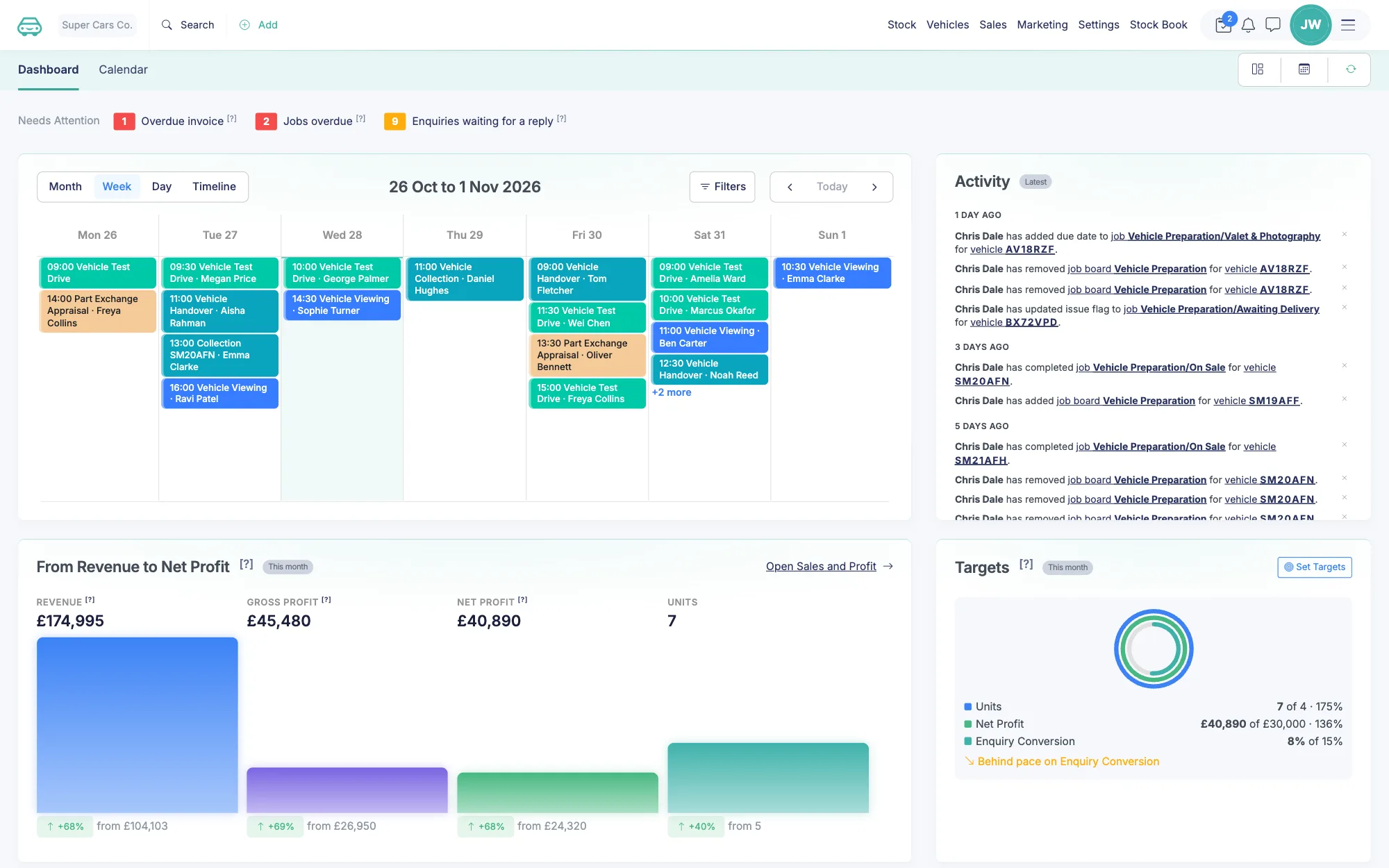
MotorDesk is the connected dealership management ecosystem for automotive retailers of every size. Stock, websites, 50+ sales channels, enquiries, sales, finance, workshop, invoicing and accounts all work from one vehicle record, so a car added once is advertised, sold, invoiced and in your accounts without anyone typing it twice.
Where Does AI Fit Into Dealership Software?
AI is becoming part of the everyday tools dealerships use, but its value depends on the information it has access to. A standalone AI tool might help write a vehicle description, for example, but it still needs someone to find the specifications, copy the details across and check the result.
When AI is built into dealership software, it can work directly with the vehicle, customer and transaction records already in the system.
That means it can help summarise and prioritise incoming enquiries, draft replies using your dealership's preferred tone, create customer records from driving licence details, and read supplier invoices into the relevant vehicle purchase record. It can also generate vehicle descriptions and attention grabbers from actual specifications, prepare branded vehicle photos and help create website content.
The important distinction is that AI should reduce repetitive administration, not take control away from the people running the dealership. Generated content can be checked, edited and approved before it is used.
What Software Do You Need At Your Size?
The core software is the same at every size: what changes is how many sites, brands, users and outside systems it has to cover.
Single Site Independent
Two things: one connected platform that covers your website, advertising feeds and calendar management, plus a live integration with accounting software like Xero. That is genuinely it.
What you don't need at this size is a standalone customer relationship management (CRM) system, or anything that charges you per use or transaction. If you are being quoted for nine subscriptions, you are the product.
Scaling Dealers And Multi-Site Operations
Same core, plus the things that stop a second site or a second brand from becoming a second business: user roles, access and permissions so the weekend staff can't delete an invoice, lead routing so an enquiry reaches the right branch rather than a shared inbox nobody owns, and reporting that shows the numbers the way the business is actually structured - by site, by trading name, by location or by division, not just in one lot.
Plenty of operations at this stage also run multiple trading names - the retail brand, the trade sales part, the leasing side - and want them under one system with separate identities: one account, distinct brands, ring-fenced reporting. This is where tracking performance properly becomes essential rather than just a nice to have.
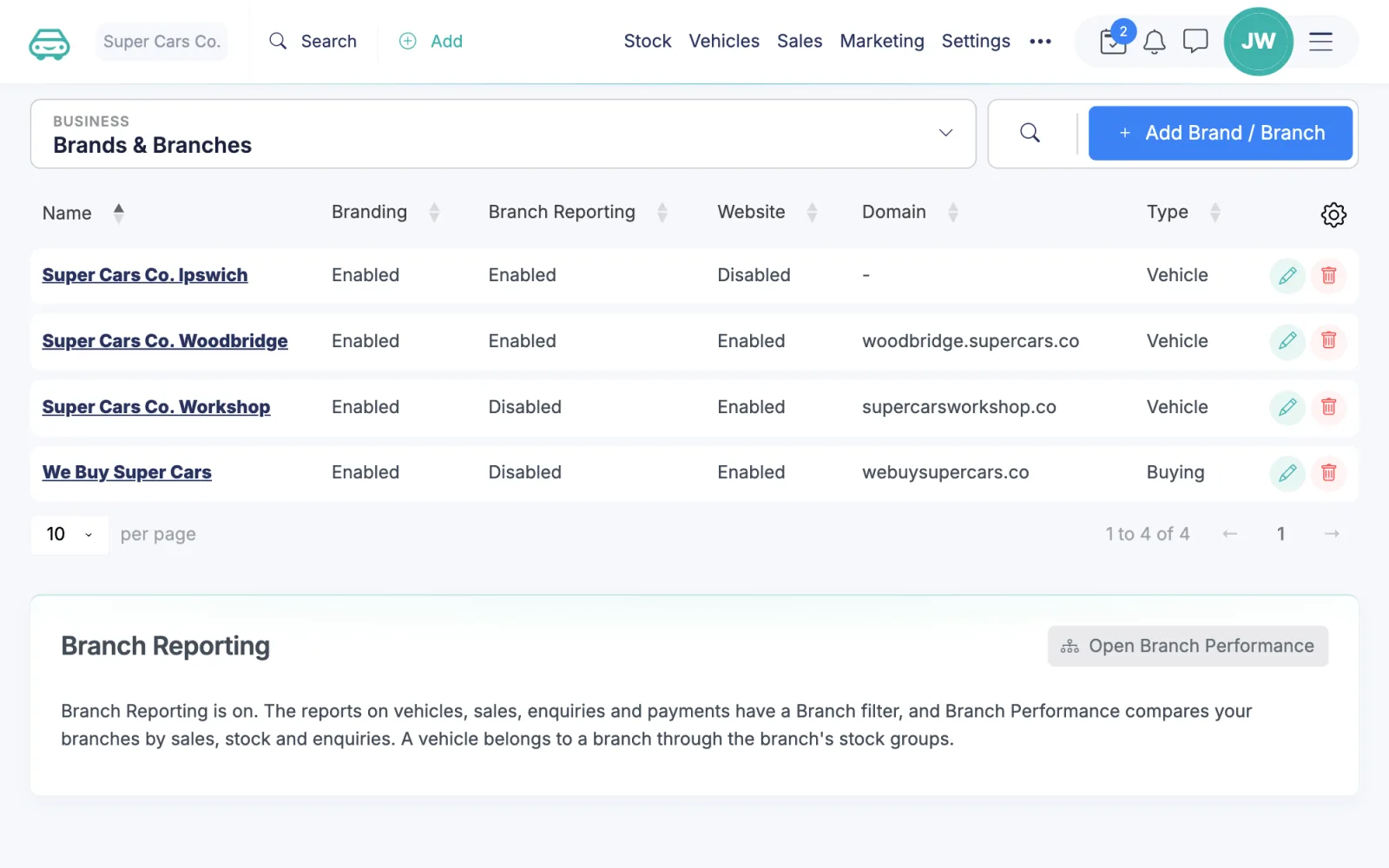
In MotorDesk 2.0 that's Brands and Branches: a Brand shows different business details on invoices and printed documents, and a Branch runs another dealership with its own stock groups and Branch Reporting. Either can have its own website, for a different brand, a location or a service such as car buying.
Staff are invited by email, a user's access can be suspended without removing them or changing their permissions, and permissions are arranged to match the new menus.
Franchised Sites And Larger Groups
Manufacturer requirements often dictate part of the stack, including original equipment manufacturer (OEM) systems, lead standards and service platforms, which is why franchised dealers have historically used large legacy DMS providers. The shift happening now is groups running a modern cloud platform for the retail side, covering stock, advertising, websites and sales, alongside whatever the OEM mandates, connected through application programming interfaces (APIs) rather than everything living in one closed system.
That's where MotorDesk's open API becomes particularly useful. If you have in-house developers or work with an agency, an open API matters more than any feature list: it's what lets the platform talk to your data, your group website and whatever the manufacturer mandates next.
MotorDesk is built to scale with your business from a single site independent all the way to a larger group, with multiple trading names in one account, reporting split by site, trading name, location or division, and even car buying websites so you can source stock directly from the public under its own brand. MotorDesk is the only car dealer software certified by Xero, QuickBooks and Sage. Add Sage 50 import/export and the API for anything bespoke, and just because your business grows you don't have to migrate and overhaul how you operate.
Can I Just Run My Dealership On A Spreadsheet?
You can, and if you sell five cars in a year, a spreadsheet might genuinely be all you need for the moment.
The problem is what happens when the dealership grows, your time becomes more valuable and compliance starts to matter just as much as sales. A spreadsheet can tell you that you bought a van for £12,000, but what it won't do is take the eBay ad down when the vehicle sells, chase the enquiry that arrived while you were mid test drive, or tell you average days in stock have increased from 35 to 60 in the last 6 months. And it certainly won't give you a clean, audit-ready trail when HMRC asks you to justify your VAT position under Making Tax Digital.
Past ten vehicles in stock, the spreadsheet costs more than software would, and the cost is exactly the thing a connected platform removes, because the vehicle, the advert, the enquiry and the invoice are the same record, not four places to keep in sync by hand. The admin doesn't necessarily feel like a huge problem on any one day. It's all the little jobs that add up and then the riskiness the moment VAT and MTD compliance need to be managed.
Do I Need A Separate CRM?
Not usually, because connected dealership software already handles every enquiry.
Enquiry handling matters hugely at every scale (the dealer who replies in ten minutes beats the one who replies tomorrow, no matter how big the dealership is), but a connected platform already includes it: every enquiry from website forms, live chat, email, phone, Auto Trader, WhatsApp, Messenger, Instagram and SMS in one place, attached to the vehicle, with follow-up reminders.
For a single-site independent, a standalone CRM on top means paying twice for the same feature and retyping customers between two systems: there is no sense to it. For groups with large dedicated sales teams, manufacturer campaigns and service retention programmes, a CRM like Salesforce or HubSpot could genuinely be worth the additional cost.
The requirement then is integration, so the CRM and the platform share customers and deals through an API instead of through someone manually re-entering the data. Either way, run whatever you choose properly: our guide to managing dealer CRM systems.
What Tools Do Dealerships Use To Advertise Vehicles?
Dealerships advertise vehicles on marketplaces such as Auto Trader, Cazoo, CarGurus, Gumtree and eBay, plus their own website and social media, ideally fed from their stock system rather than a separate tool.
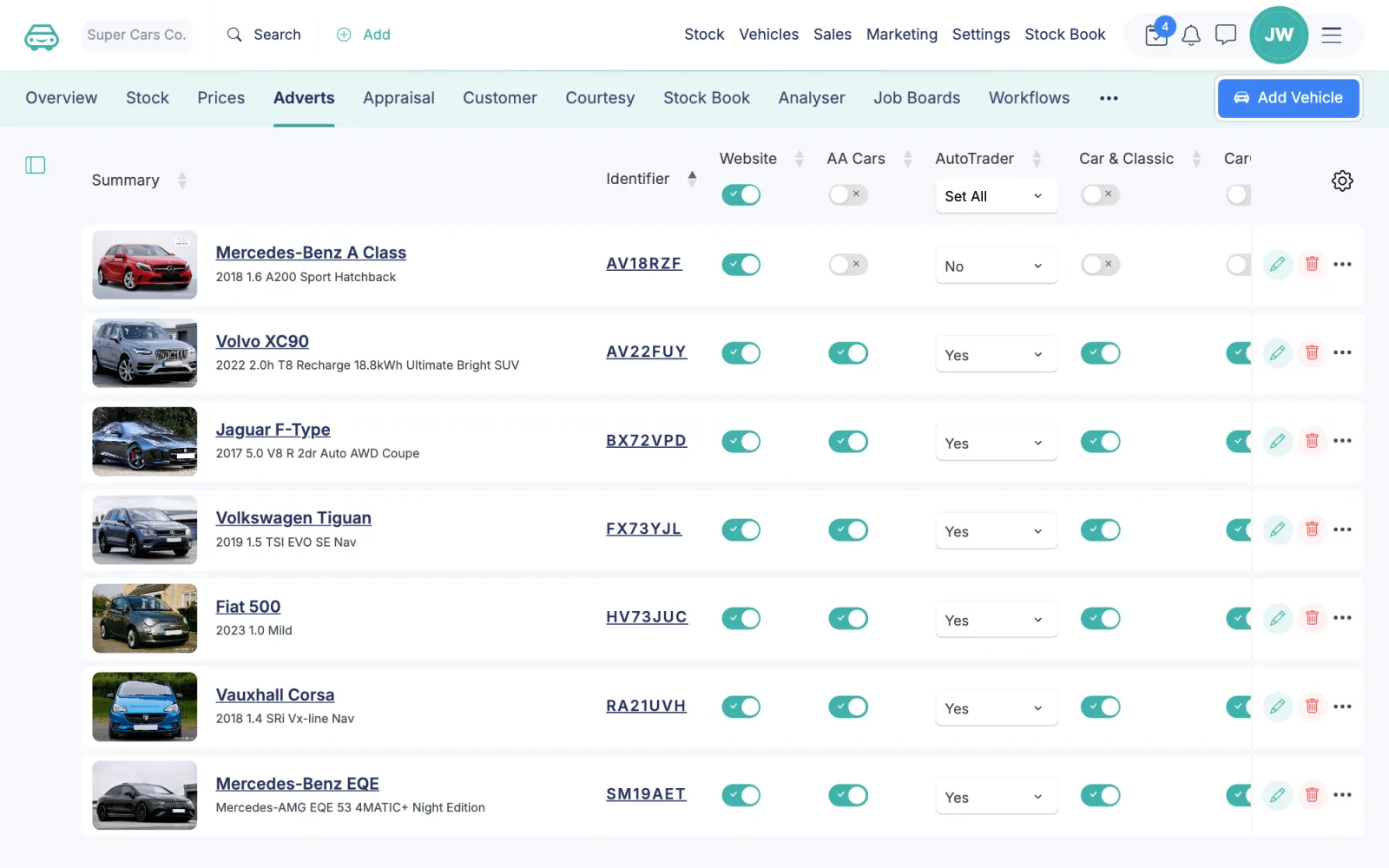
These don't need to be bought separately: the feed belongs in the platform. Check that any system you're considering pushes vehicles to the channels you actually use and pulls the ad the instant the car sells (MotorDesk connects to Auto Trader via its API, along with eBay, Facebook, CarGurus and a growing list of marketplace integrations - 50+ sales channels from one listing).
In MotorDesk, each car's sales channels can be switched on or off one by one, so you choose where every vehicle appears.
And check it covers your vehicle type. Plenty of "dealer software" doesn't work well for motorbikes and caravans - car-only data lookups, car-only marketplace feeds and nowhere to put berths.
Do Dealerships Need A Social Media Management Tool?
You don't need a social media tool; you need social media to stop being a full-time job.
Two things make that true:
Automated Posting
A new arrival comes onto the platform, and it's posted to Facebook, Instagram, TikTok, YouTube, LinkedIn, X and Google Business Profile with the photos and details already attached, within the posting hours you set. That's social media automation, and it's the difference between a page that's active every week and one whose last post was from 2025.
Generic social schedulers aren't able to handle a vehicle, and they certainly don't have your branding and colours, so you'll be back to copy-and-pasting listings, which is the job you were trying to eliminate.
In MotorDesk you connect each network under Settings → Connections → Social Networks, choose a template for the layout, colours and where the logo and price sit, and set your Post Settings, such as Post Within Times and Maximum Posts per Day. In 2.0, social posts, reviews and your blog sit together in the Marketing section.
Enquiry Responses
Social media enquiries go dead fast, so they should land in the same inbox as all of your other enquiries from your website and Auto Trader leads. MotorDesk does this through an official Meta messaging integration, so Messenger, Instagram and WhatsApp messages get handled like any other enquiry, against the vehicle, with a name attached.
What Accounting Software Do Car Dealers Use?
Xero, Sage and QuickBooks are the leaders in accounting software, but standard accounting software isn't designed around the complexities of motor retail. A dealership needs to track more than just income and expenses - each vehicle has its own purchase costs, preparation costs, sale price, VAT treatment and profit margin.
The VAT margin scheme is a particularly important consideration. Dealers need to accurately track the purchase and sale of individual vehicles and calculate VAT on the margin, rather than simply applying VAT to the full selling price. Managing this manually in general accounting software creates additional administration and increases the risk of errors.
A connected system keeps vehicle-level costs, sales, VAT and profit linked to the relevant deal, while accounting software handles the wider accounts. Supplier invoices can also be read into the relevant vehicle purchase record, reducing manual entry and helping ensure preparation and other costs are accounted for. The result is a clearer financial picture, with records ready for your accountant or an inspection.
With every transaction linking back to a deal, a customer or a vehicle, your financial records always stay aligned with what is actually happening in your dealership. Accountants and auditors are able to trace each line in the accounts back to its source, investigate and access the information instantly rather than having to spend time piecing together each element.
Most importantly, it provides live, accurate financial information without duplicating work.
More information on motor trade accounting can be found in our accounting and bookkeeping guide; if you're a sole trader, note the Making Tax Digital changes coming your way too.
What Finance And Payment Software Do Dealers Need?
Dealers need finance software that brings quotes, proposals and applications into the deal, and payment software that takes deposits, reservations and settlements, online and in the showroom.
Finance is how buyers fund a vehicle. Dealers work with lenders or brokers to submit finance proposals, and need the appropriate Financial Conduct Authority (FCA) authorisation, or to be an appointed representative of an authorised firm, to offer finance. See our legal requirements guide.
The process doesn't have to live in a separate portal. Connected dealership software can bring finance quotes, proposals and applications into the deal itself, using the same customer and vehicle records. Finance calculators can also be displayed on your website, showing monthly payments on individual vehicles, with deposits and terms adjustable and representative examples included.
This matters because many buyers shop by monthly budget, not just screen price. Showing finance options alongside your stock gives them a clearer idea of what a vehicle could cost and makes it easier to take the next step, with an application form available from the same place.
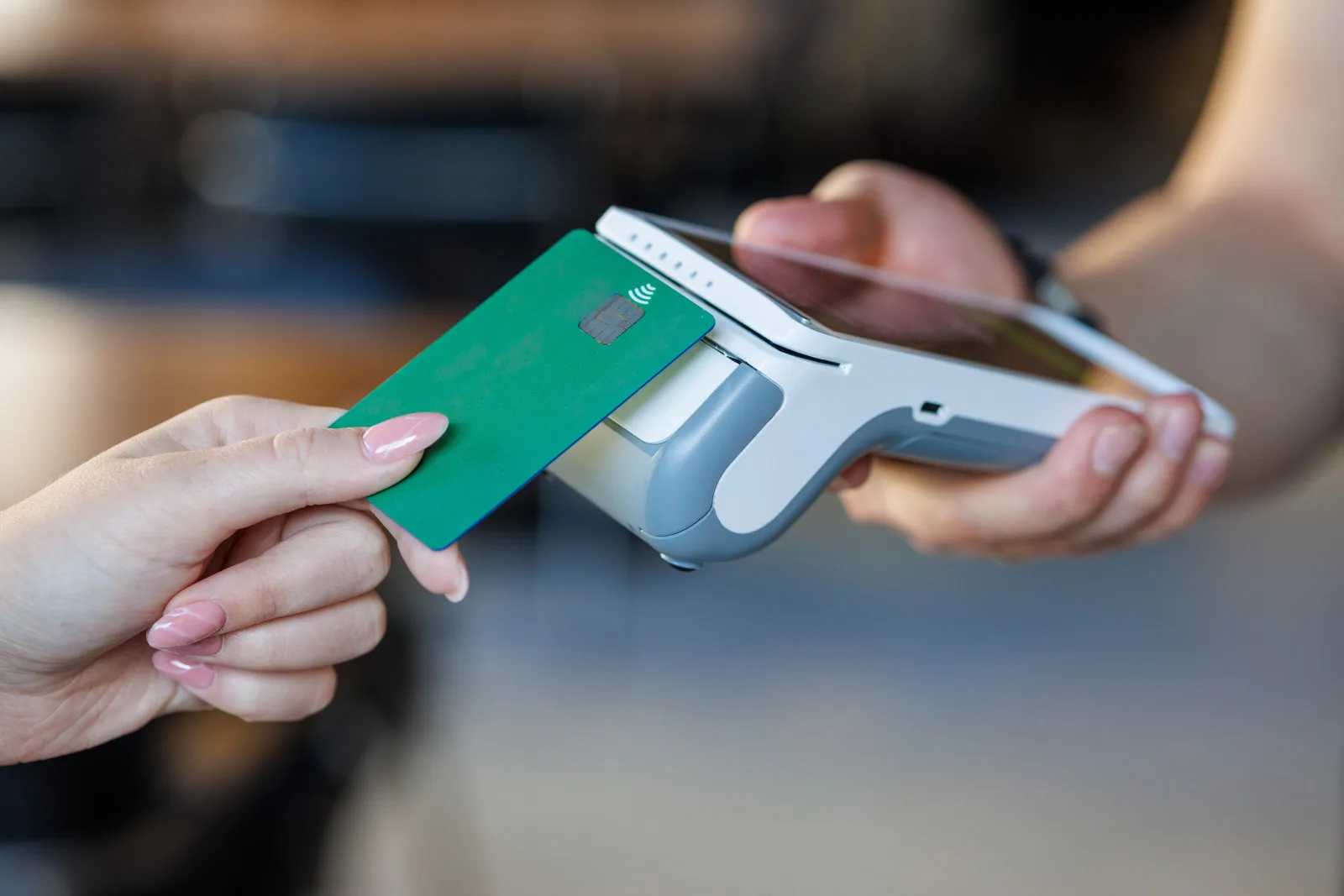
Payments are how money moves between the buyer and dealership: deposits, reservations and settlements. The traditional approach of taking card details over the phone and entering them into a terminal can be awkward for both sides, particularly when a customer wants to secure a vehicle outside business hours.
Online checkout brings this into the sales process. MotorDesk's online checkout and Deals does this end to end: a buyer can reserve a vehicle and pay a deposit with the payment recorded against the deal automatically. Part-exchange details, finance and payments all sit within the same process, rather than being managed across separate tools.
For dealers, this means fewer manual steps and a clearer record of each transaction. For customers, it makes it easier to commit to a vehicle when they're ready, even if that's after the dealership has closed.
In MotorDesk 2.0, Deal Builder is now simply called Deals, and it's switched on for every plan that includes it, with no Activate step. Finance connects to providers including iVendi, Codeweavers, Evolution Funding, DSG, Jigsaw Finance, CarFinance 247 and Auto Trader Finance, and payments run through Stripe, Acquired, takepayments (online and on card terminals) and Bumper.
How Much Does Car Dealership Software Cost In The UK?
Car dealership software costs vary depending on stock volume, users, integrations and the features included. Typical monthly costs in the UK:
- Traditional DMS (plus the add-ons it doesn't include): often £250 - £5,000+/month, plus set-up fees, per-user charges and long contracts, before you add the website, advertising and lead tools separately
- Standalone CRM: £30 - £100+/month per user
- Accounting: £25 - £500/month
- Connected dealership management ecosystem: from £79/month + VAT and scales by your stock volume; MotorDesk's pricing is public
When comparing providers, consider the total cost of your DMS, website, advertising, CRM and accounting tools, rather than just the base subscription.
Beyond the time saved, it's worth considering the wider benefits: lower administration costs, fewer opportunities for manual errors and more time for your team to focus on running the business.
For an example of current plans and costs, see MotorDesk's pricing: there are no set-up fees, no minimum contract and a 30-day free trial with every feature.
The Bottom Line
The dealership software question has been made complicated by the motor industry. It isn't.
A DMS only manages the stock. MotorDesk runs the dealership.
Running a dealership means your stock, website, advertising, enquiries, sales, finance, invoicing and accounts all working off the same vehicle, customer and deal, so you add and appraise a car once, and it's advertised, sold, invoiced and in your accounts without anyone typing it twice. That's a connected platform, not a bunch of monthly subscriptions.
Everything else has to earn its place by saving more time than it costs, because you got into the business of selling vehicles, not switching between nine log-ins.
Frequently Asked Questions
What Software Do Most UK Car Dealers Use?
Most UK car dealers use a dealer management system (DMS) for stock and sales, alongside tools for advertising, customer enquiries, finance and accounting. Some dealerships use separate products, while others choose a connected platform that brings these functions together.
How User Friendly Is A Dealership Management Ecosystem?
Easier than the old DMS-plus-bolt-ons, not harder: one login, one place to learn, and every detail entered once. A good ecosystem adds a vehicle from its registration, then carries it through advertising, enquiries, sales and accounts on its own. MotorDesk is cloud-based and works on any device, and the rebuilt 2.0 interface adds a main menu with your favourites, search from the header (including by photo or voice), Quick Add and every setting in one place, in seven groups. Getting Started shows your set-up progress in six stages, from Who You Are to Go Live.
How Easy Is It To Integrate A Connected Dealership Ecosystem With Existing Systems?
Straightforward, because the integrations are built in rather than bolted on. A connected ecosystem already talks to the sales channels, accounting packages and payment providers dealers use, and an open API connects anything bespoke, such as a group website or an OEM system. MotorDesk is the only car dealer software certified by Xero, QuickBooks and Sage, feeds 50+ sales channels and has a public API.
Can A DMS Replace A Standalone CRM?
No. A DMS may need a separate CRM, as most only have basic lead and enquiry management. A connected ecosystem already handles every enquiry, from website forms, live chat, email, phone, Auto Trader, WhatsApp, Messenger, Instagram and SMS, in one inbox, attached to the vehicle. A standalone CRM only pays off for larger groups, and only if it integrates through an API.
Does Dealership Software Work For Vans, Motorbikes Or Caravans?
Yes. The good platforms do. The trap is car-only systems with car-only data lookups and feeds, so have a supplier demo your vehicle type end to end first. MotorDesk handles cars, vans, motorbikes, caravans and campervans natively.
Get Started
If you'd like to see how your business could run with MotorDesk watch a MotorDesk demo or start a free trial.